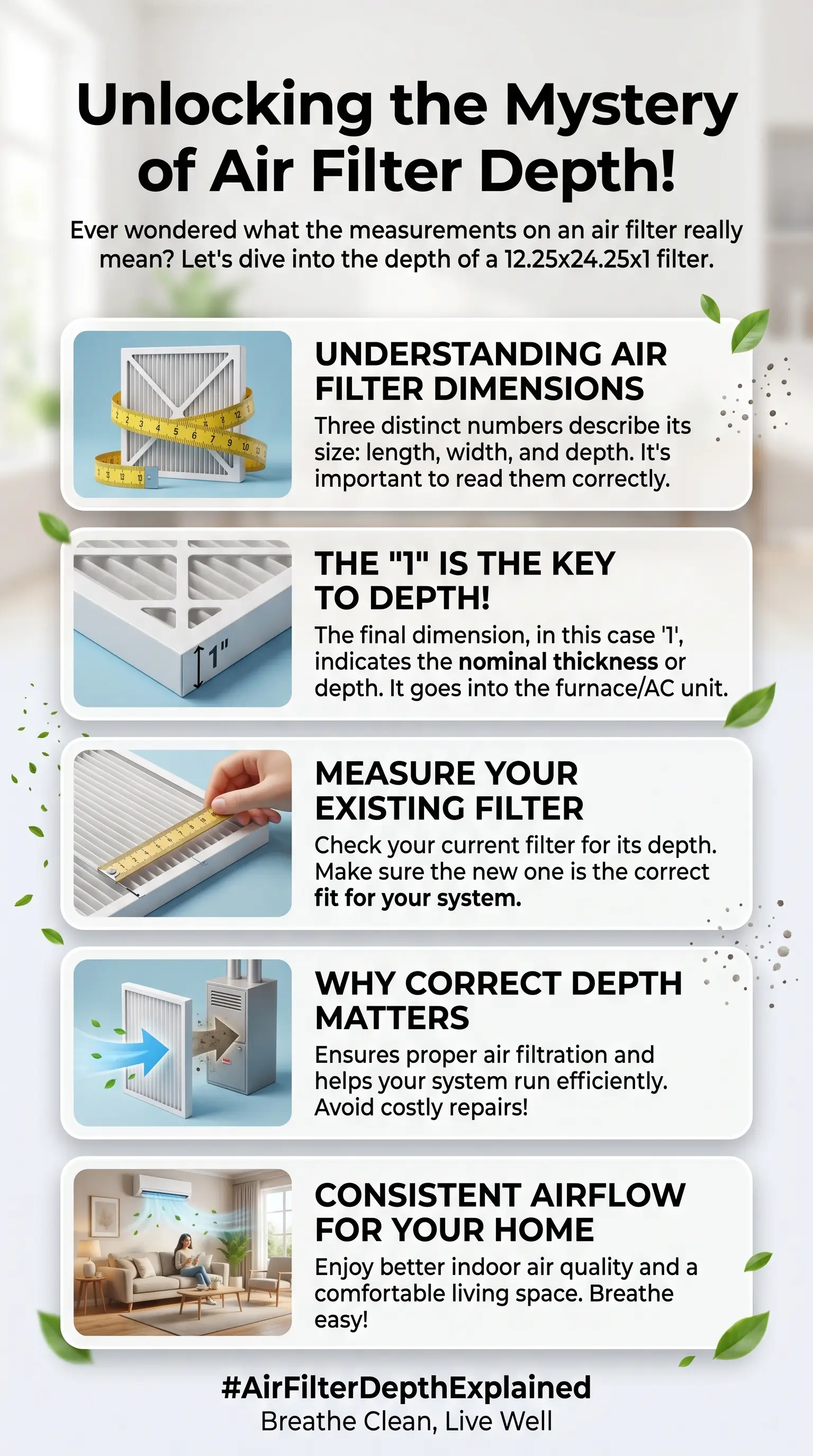
Slide your old filter out and read the frame. Three numbers run along the edge, and the last one, the 1, is the depth. On a 12.25x24.25x1 filter, that means one inch thick. I have pulled thousands of these out of furnaces and air handlers, and the depth is the number most people skip right past, even though it decides whether the filter seats properly or sits loose in the slot.
Width and height get all the attention, since they cover the return vent you actually see. The depth does the quiet work. It has to match your slot, and a small mismatch there causes the biggest headaches. I will show you what that one inch really measures, how the printed label stacks up against a tape reading, and why a quarter inch of extra room lets your air slip past the filter instead of through it. If you already know your slot takes a one-inch filter and you just want the right fit, you can order custom 12.25x24.25x1 air filter sizes and be done. Matching that depth is also how you maintain steady, healthy airflow from the day it goes in.
Quick Answers
What Is the Depth of a 12.25x24.25x1 Air Filter?
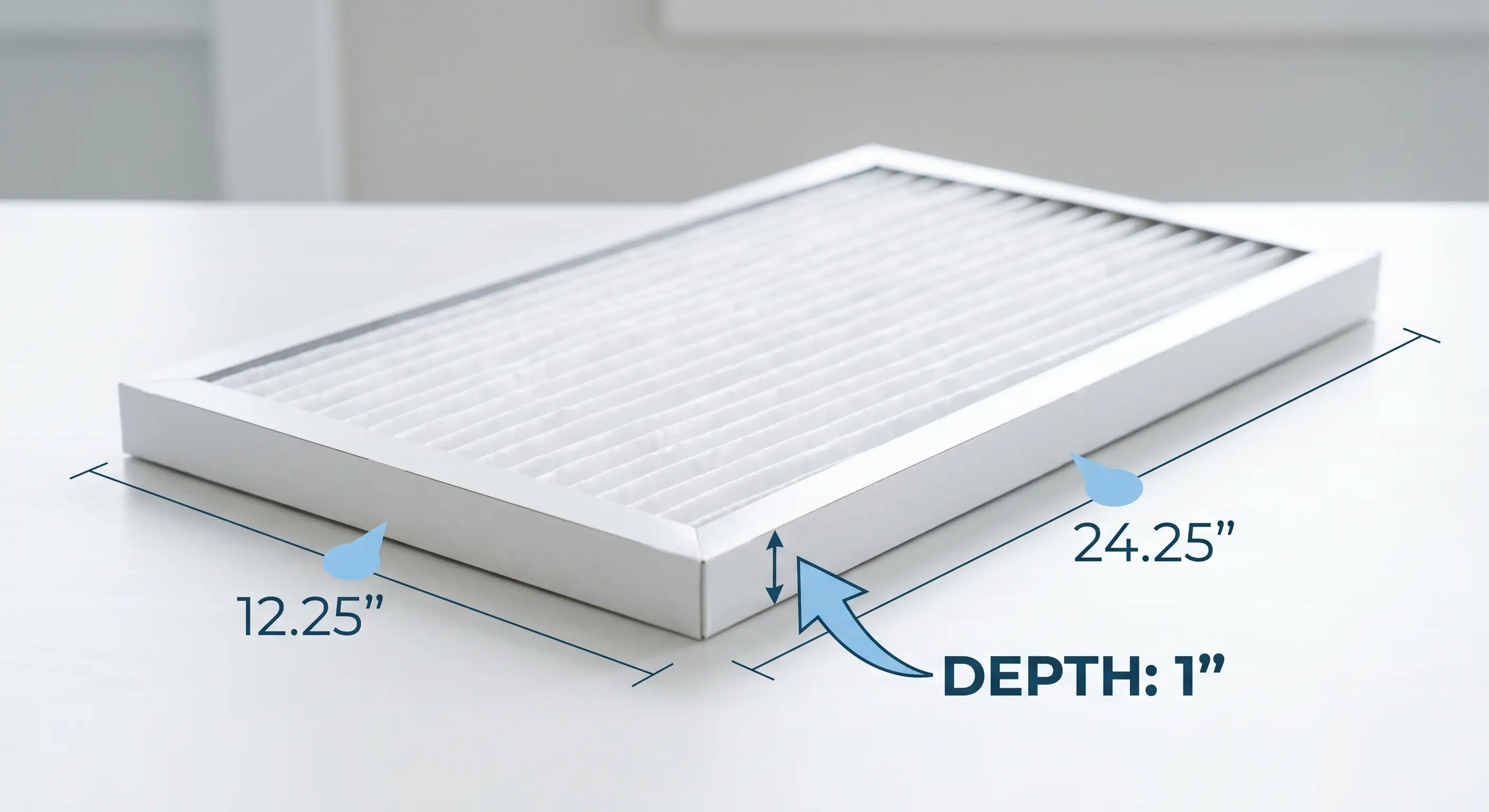
The depth of a 12.25x24.25x1 air filter is one inch. In any filter size, the third number is the thickness, so this is a one-inch filter that measures 12.25 inches wide and 24.25 inches tall. Lay a tape across the frame and the real depth usually reads a little under a full inch.
Depth is the third number. It tells you the filter is one inch thick.
Width and height come first. This one measures 12.25 by 24.25 inches across the face.
The real depth runs a little short. A one-inch filter usually tapes out near three-quarters of an inch.
Fit comes down to the slot. A one-inch filter belongs in a one-inch rack, not a deeper housing.
Thinner filters need changing sooner. A one inch fills up faster than a two or four inch.
Top Takeaways
The 1 in 12.25x24.25x1 is the depth, and it equals one inch.
The 12.25 and 24.25 are already exact measurements, so this size is precise rather than rounded.
Match the depth to your slot first, then stay on a smart change schedule once it is in.
A one-inch filter handles everyday air just fine, and you can step up to pleated media for finer capture without touching the depth.
If changes slip your mind, keeping convenient multi-pack replacements on the shelf makes it easy to stay current.
Every air filter prints its size the same way: width, then height, then depth. The depth is the part that drops into the slot, and it is the one that decides whether air moves through the media or finds a gap and goes around it. On this size, that depth is one inch.
Here is where people get tripped up. Plenty of filter sizes are nominal, which is a polite way of saying the label rounds off. A filter sold as 16x25x1 usually measures closer to 15.5 by 24.5 inches. This size plays it straighter. The 12.25 and 24.25 are already written to the quarter inch, which tells me the maker listed the real face dimensions instead of rounding them. The depth still follows the old habit. The label says one inch, but when I run a tape across the body of the filter, it reads just under that, usually close to three-quarters. For a plain refresher on home filtration, this guide to cleaner air throughout your home covers the basics, and this hands-on sizing walkthrough shows you how to check your own numbers.
A quarter inch sounds like nothing until it costs you. Your furnace or air handler has a slot built for one specific depth. Push a one-inch filter into a one-inch rack and it seats flush against the frame. Try to wedge a thicker filter into that same slot and it either jams or stops the cover from latching. Run it the other way, and a one-inch filter dropped into a four-inch housing leaves an open gap that lets dirty air coast right past the media.
Depth changes how the filter performs, too. A one-inch frame has less room for pleats than a thick one, so it holds less dust and asks to be swapped sooner. That is a fair trade, not a weakness. One-inch filters cost less and fit the widest range of systems out there. If you are sorting out how much filtration you actually need, this simple efficiency scale walks through the MERV range, and an affordable pleated upgrade raises capture without changing the one-inch depth your system was built for.
“The sizing mistake I see most often is a homeowner who nails the width and height and then gets the depth wrong, which leaves a gap that quietly cancels out the whole filter.”
7 Essential Resources
If your setup runs off a boiler, this deep look at boiler filters explains how that media works differently.
For a one-inch pleated filter done right, here is a solid breakdown on choosing a pleated filter that performs.
If filter ratings are new to you, start with what MERV ratings really mean.
For a side-by-side comparison, this clear guide to filter efficiency lays it out.
Before you settle on a rating, it pays to test your indoor air quality first.
To sort HEPA from MERV, this resource helps you understand higher-efficiency filtration.
For a house full of allergy triggers, here is the case for better protection for allergy sufferers.
3 Statistics
Indoor air often carries two to five times more pollutants than the air outside, according to the EPA. A filter that seats correctly is your first line of defense against that load.
Heating and cooling eat up close to half of a typical home’s energy use, and ENERGY STAR points out that a clogged filter chokes airflow and pushes the system to work harder. The right depth keeps that air moving.
People spend roughly 90 percent of their time inside, the NIEHS reports, so the air running through your one-inch filter is the air you breathe most of the day.
Final Thoughts and Opinion
After years of handling these filters, I will say it plainly. Depth is not a small detail. It is the number that makes the other two worth anything. Get the one inch right, seat the filter flush, and the rest of the size does its job without a fuss. If you want a starting point for a filter you can count on, you can find a filter you can rely on and weigh it against real-world filtration comparisons before you buy.
My honest take is that most homes do great on a quality one-inch pleated filter swapped on a regular schedule. If your air needs run higher, a higher-efficiency choice earns its keep, as long as your system is rated to pull air through it.
Frequently Asked Questions
Is the depth exactly one inch?
The label says one inch, and that is the size you order. In the slot, the body of a one-inch filter usually measures a touch under, often near three-quarters of an inch. That small gap is normal and already figured into how the slot is built.
What does the third number in the size mean?
It is the depth, also called thickness. Filter sizes always read width by height by depth, so the third number tells you which slot the filter fits.
Can I use a thicker filter instead?
Only if your slot is built for one. A one-inch rack will not hold a two-inch or four-inch filter without a converter. If you have another return that takes a slim filter, a similar slim-profile size may fit that opening better.
How do I measure the actual depth?
Lay the filter flat and run a tape across the edge of the frame, from one face to the other. That edge measurement is your true depth, and it is what has to match the slot.
Are these filters available outside the United States?
Yes. If you are shopping north of the border, you will find options for Canadian homes in the usual one-inch sizes.
Ready to Breath Cleaner Air
Depth is the one number worth checking twice before you buy, because a one-inch filter only earns its place in a one-inch slot. Measure your slot, match it, and if your system is built to handle more, a heavy-duty filtration option buys you extra room between changes.
Learn more about HVAC Care from one of our HVAC solutions branches…
Filterbuy HVAC Solutions - Miami FL - Air Conditioning Service
1300 S Miami Ave Apt 4806 Miami FL 33130
(305) 306-5027
https://maps.app.goo.gl/Ci1vrL596LhvXKU79